Our Location
304 North Cardinal St.
Dorchester Center, MA 02124
 Skip to content

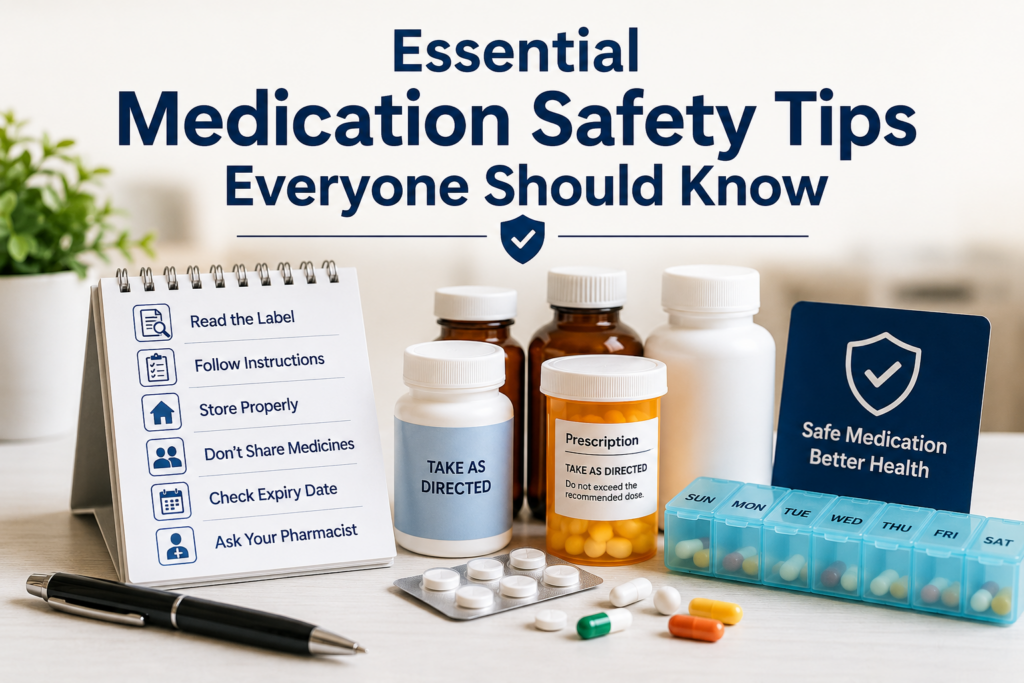
Medication safety tips can help reduce mistakes and support safer medicine use in everyday life. Medicines play an important role in treating illnesses, relieving symptoms, and improving quality of life. However, even helpful medications can create problems when they are taken incorrectly, stored improperly, or mixed without proper guidance. Medication safety is not only about following instructions—it is also about building small habits that reduce avoidable mistakes.
Whether you take medicines regularly or only occasionally, these medication safety tips can help you stay more organized, informed, and confident when using medicines.
As part of good medication safety tips, take a moment to read the label and instructions before taking any medicine. Check:

Many medication errors happen simply because people assume they already know how to use a medicine. Therefore, reviewing instructions carefully can help reduce mistakes.Many medication errors happen simply because people assume they already know how to use a medicine.
Taking more medication does not necessarily mean faster results. Similarly, taking less may reduce effectiveness.
Instead, use the amount directed by your healthcare professional or the package instructions and avoid changing doses on your own.

If you use multiple medicines, maintain an updated list that includes:
As a result, this habit becomes especially useful during medical appointments or emergencies.
You may also find it helpful to review medicine management resources from NHS Medicines.
Some medications, supplements, and even common over-the-counter products may interact with each other.
Therefore, before combining products, check with a qualified healthcare professional—especially if you are already taking regular medication. General guidance on medication safety is also available from World Health Organization (WHO).
Proper storage is one of the most important medication safety tips, yet many people overlook it.
For example, general medication storage tips include:
Consequently, heat and moisture can affect how some medicines perform. For more general healthcare information, visit our website information pages.
About Us. You can read additional recommendations on the safe use of medicines from U.S. Food & Drug Administration (FDA).
A medicine that works for one person may not be suitable for someone else.
Furthermore, sharing medication can increase the risk of incorrect dosing, unwanted effects, or delayed treatment.Sharing medication can increase the risk of incorrect dosing, unwanted effects, or delayed treatment.
Following medication safety tips can become difficult when busy schedules lead to missed doses.
To make things easier, helpful methods include:
As a result, consistency often improves medication effectiveness.
Pay attention when starting a new medicine.
If you notice unusual symptoms or unexpected changes, seek advice from a qualified healthcare professional rather than making assumptions.If you notice unusual symptoms or unexpected changes, seek advice from a qualified healthcare professional instead of making assumptions.
Expired medicines may not work as intended.
Therefore, review medicine cabinets every few months and safely dispose of expired products according to local guidance.
One of the most practical medication safety tips is staying informed without trying to memorize every medical detail.
Simple questions can make a difference:
Understanding your medication helps you use it more confidently and responsibly.
These medication safety tips are built around simple everyday decisions. Ultimately, reading labels, staying organized, following instructions, and asking questions can reduce mistakes and support safer medicine use.
Small habits today can make medication use simpler, safer, and more effective over time.
 Optimized by Seraphinite Accelerator